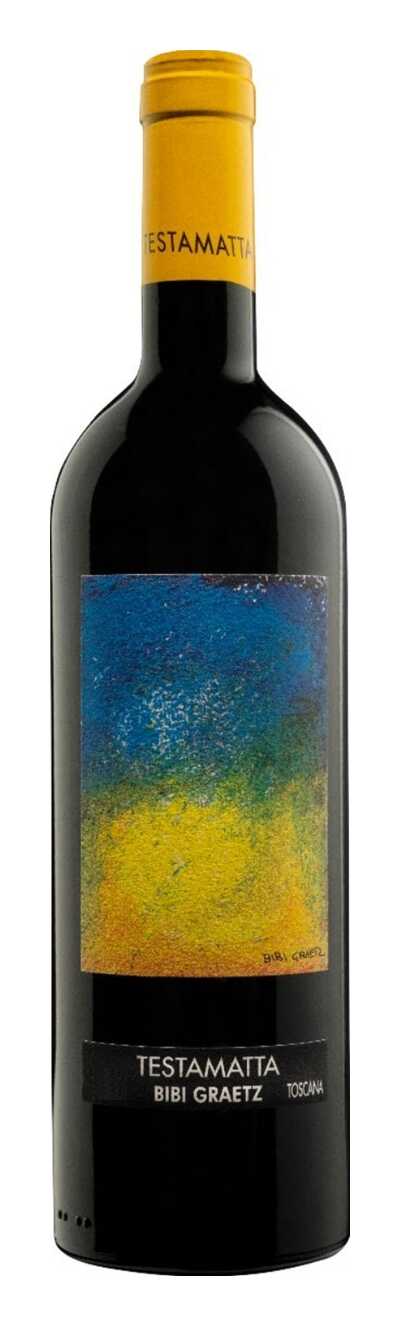
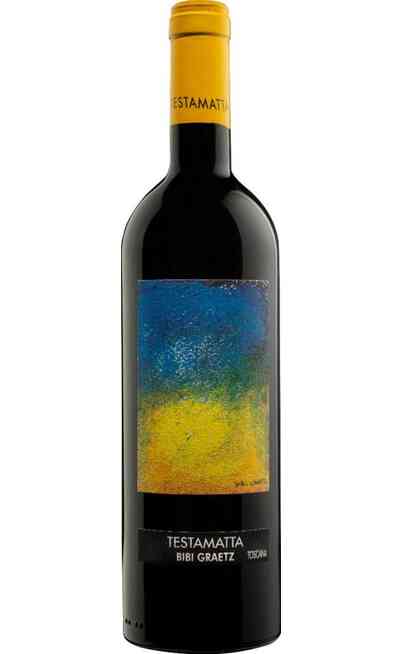
Toscana Rosso TESTAMATTA ROSSO 2022 BIBI GRAETZ
| Sommelier score | 94/100 | 2026 |

| Winery | BIBI GRAETZ |
| Denomination | Toscana Igt |
| Vintage | 2022 |
| Grapes | 100% Sangiovese |
| Alcohol content | 14,00% |
| Cl | 75cl |
| Sulfites | Contains sulphites |
| Winery headquarter | BIBI GRAETZ - Fiesole (FI) - Via di Vincigliata, 19 |
| Bottle size | Standard bottle |
| Combination | Florentina Steak, Cold cuts and salami, Lamb, spicy cheese, Hard cheese, Grilled meat, Pasta with meat sauce, Scallops with mushrooms, Meat and game stew, wild game, mushroom risotto |
| Region | Tuscany (Italy) |
| Style | Full-bodied and intense |
| Wine list | Toscana Igt |
Testamatta is a wine that represents the purest and most distinctive essence of Sangiovese, according to Bibi Graetz, interpreting the grape variety through historic vineyards located in the most suitable areas of Tuscany. It was born from a rigorous selection of grapes from old vineyards, distributed between ventilated hills and terroirs characterized by different altitudes and soils rich in skeleton, clays and galestro. The harvest is carried out manually and several times on the same vineyards to harvest each plot at its perfect ripening point. After a careful double selection, in the vineyard and cellar, the grapes are destemmed and sent for fermentation in open barriques, where they are made with indigenous yeasts and without artificial temperature control. During fermentation, frequent manual fulling is performed, which promotes gentle and complete extraction. Winemaking takes place by keeping the individual parcels separate, so as to preserve the identity of each vineyard. After alcoholic fermentation, the wine undergoes malolactic fermentation and continues a long aging process in wood, which lasts for approximately 18–20 months between barriques and barrels, before final assembly. The result is a Sangiovese of great finesse and expressiveness, combining elegance, freshness and aromatic complexity, always maintaining a strong territorial imprint and a remarkable capacity for evolution over time. The 2022 vintage features a more concentrated and structured wine than the previous year, thanks to the particularly warm climate.
Characteristics of this supertuscan wine
The Testamatta appears in the glass with a bright, transparent ruby red color, typical of the high-hill Sangiovese, which reveals a good vivacity and chromatic finesse. It expresses great elegance and aromatic precision in its sense of smell. The first impact is dominated by sharp notes of fresh red fruits such as cherry, wild strawberry and raspberry, accompanied by a sensation of crunch and freshness. With oxygenation, the bouquet expands towards delicate floral nuances and light spicy notes, always maintaining a clean, linear profile consistent with the varietal identity. The aromatic component is refined, without excessive concentration, but plays on the finesse and definition of the fruit. On the palate, the entrance is fresh, vibrant and slender, supported by a very present acidity that gives dynamism and gustatory tension. The structure is medium, elegant, with fine, silky tannins perfectly integrated into the body of the wine. The center of the mouth is consistent with the nose, with returns of crisp red fruit and a pleasant mineral sensation that contributes to the depth of the sip. The finish is long, clean and very persistent, characterized by a feeling of freshness and fruity and slightly spicy returns. Overall, the wine stands out for its balance, finesse and territorial expressiveness, with a style based more on elegance than power.
Recommended pairings with this Bibi Graetz wine
It pairs particularly effectively with traditional Tuscan and Italian dishes based on less overly structured white and red meats, such as roasts, mixed grills, noble poultry, and stewed rabbit. It also lends itself very well to savory first courses with meat sauces, such as pappardelle with hare ragù or pasta with Tuscan ragù. Excellent pairing with aged cured meats and medium or long-aged cheeses, such as not too spicy pecorini or well-developed hard cheeses. The ideal service temperature is between 16 and 18 °C.
![Mediterra Toscana [Poggio al Tesoro]](https://data.negoziodelvino.it/imgprodotto/mediterra-toscana_15270_ico.jpg "Mediterra Toscana [Poggio al Tesoro]")
![Montepulciano d'Abruzzo DOP BIO [TOLLO]](https://data.negoziodelvino.it/imgprodotto/montepulciano-dabruzzo-dop-bio_14402_ico.jpg "Montepulciano d'Abruzzo DOP BIO [TOLLO]")
![Franciacorta Brut "Rhino" DOCG in Box [CA' DE PAZZI]](https://data.negoziodelvino.it/imgprodotto/franciacorta-brut-rhino-docg-in-box_14131_ico.jpg "Franciacorta Brut \"Rhino\" DOCG in Box [CA' DE PAZZI]")
![Fiano Sannio "Colle di Tilio" DOP [LA GUARDIENSE]](https://data.negoziodelvino.it/imgprodotto/fiano-sannio-colle-di-tilio-dop_12747_ico.jpg "Fiano Sannio \"Colle di Tilio\" DOP [LA GUARDIENSE]")
![Isola dei Nuraghi "Spantau" BIO [ANTIGORI]](https://data.negoziodelvino.it/imgprodotto/isola-dei-nuraghi-spantau-bio_13684_ico.jpg "Isola dei Nuraghi \"Spantau\" BIO [ANTIGORI]")
![Recioto della Valpolicella DOCG [Musella]](https://data.negoziodelvino.it/imgprodotto/recioto-della-valpolicella-docg_13117_ico.jpg "Recioto della Valpolicella DOCG [Musella]")
![Pinot Bianco "Barthenau Vigna S. Michele" DOC [Hofstatter]](https://data.negoziodelvino.it/imgprodotto/pinot-bianco-barthenau-vigna-s-michele-doc_6537_ico.jpg "Pinot Bianco \"Barthenau Vigna S. Michele\" DOC [Hofstatter]")
![Schioppettino MYÒ DOC [ZORZETTIG]](https://data.negoziodelvino.it/imgprodotto/schioppettino-myò-doc_15884_ico.jpg "Schioppettino MYÒ DOC [ZORZETTIG]")
![Barbera d'Asti Superiore VILLA PATTONO DOP [RATTI]](https://data.negoziodelvino.it/imgprodotto/barbera-dasti-superiore-villa-pattono-dop_16632_ico.jpg "Barbera d'Asti Superiore VILLA PATTONO DOP [RATTI]")
![Moscadello di Montalcino DOC [Il Poggione]](https://data.negoziodelvino.it/imgprodotto/moscadello-di-montalcino-doc_5529_ico.jpg "Moscadello di Montalcino DOC [Il Poggione]")
![Sforzato "RONCO DEL PICCHIO" DOCG 2018 [Sandro Fay]](https://data.negoziodelvino.it/imgprodotto/sforzato-ronco-del-picchio-docg-2018_8440_ico.jpg "Sforzato \"RONCO DEL PICCHIO\" DOCG 2018 [Sandro Fay]")