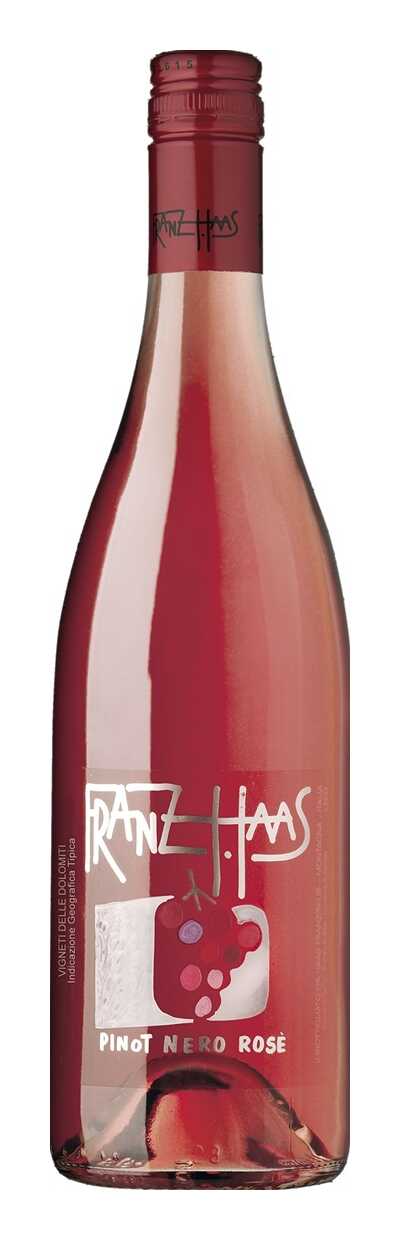
Pinot Nero Rosé FRANZ HAAS
| Points sommelier | 93/100 | 2026 |

| Cave | FRANZ HAAS |
| Dénomination | Vigneti delle Dolomiti Igt |
| Millesime | 2025 |
| Cépages | 100% Pinot Nero |
| Degré alcoolique | 13,50% |
| Cl | 75cl |
| Sulfites | Contient des sulfites |
| Siège de la Cave | FRANZ HAAS - Montagna (BZ) - Via Villa, 6 |
| Bottle size | Standard bottle |
| Combination | Aperitif, Warm fish appetizers, Smoked Fish appetizers, White Meat, Mussels, Crustaceans, Oysters, Pasta with tuna, Spaghetti with sea urchins, Tartare-fish carpaccio, Tuna fillet in pistachios crust, Sushi-sashimi |
| Region | Trentino-Alto Adige (Italy) |
| Style | Light and fresh |
| Wine list | Pinot Rosè |
| Dichiarazione Nutrizionale, Ingredienti e Raccolta differenziata | Visualizza le informazioni nutrizionali |
Franz Haas' Pinot Noir Rosé is made from Pinot Noir grapes grown in vineyards located between approximately 700 and 750 meters above sea level, on dolomitic soils with a strong erosive component. The vineyards are raised in Guyot and characterized by high planting density, with low yields to ensure high grape quality. After manual harvesting, the grapes are destemmed and pressed gently, as with white wines. The must then ferments in temperature-controlled steel tanks to preserve freshness and aromatic fineness. The wine then undergoes malolactic fermentation and ages for a few months in steel before bottling, thus maintaining a crisp, fragrant and immediate style.
Characteristics of this South Tyrolean wine
It appears with a pale pinkish color that recalls the light cherry. The bouquet is fresh and fruity, with evident notes of raspberry, currant and cherry, accompanied by light floral nuances and a slight herbaceous sensation on the finish. In the mouth it is slim, agile and very drinkable, with a fresh profile and a delicate but balanced structure. The acidic component gives liveliness to the sip, while the finish is clean, fruity and slightly savoury, with good aromatic persistence for the type.
Recommended pairings with this Franz Haas rosé wine
This rosé lends itself very well as an aperitif wine but also as an accompaniment to simple, Mediterranean cuisine. It pairs with fish appetizers, light shellfish dishes, delicate first courses and not too elaborate white meats. It is also interesting with delicate cured meats and fresh cheeses, where its freshness manages to balance the fat component. The ideal serving temperature is around 10–12°C, slightly lower than light reds, to best enhance its aromatic freshness and drinkability.
![Prosecco DOC Treviso Brut CALMAGGIORE [MASOTTINA]](https://data.negoziodelvino.it/imgprodotto/prosecco-doc-treviso-brut-calmaggiore_17321_ico.jpg "Prosecco DOC Treviso Brut CALMAGGIORE [MASOTTINA]")
![Champagne Brut AOC "Collection 245" [LOUIS ROEDERER]](https://data.negoziodelvino.it/imgprodotto/champagne-brut-aoc-collection-245_15381_ico.jpg "Champagne Brut AOC \"Collection 245\" [LOUIS ROEDERER]")
![Prosecco DOC Rosé Brut [CANTINA RAUSCEDO]](https://data.negoziodelvino.it/imgprodotto/prosecco-doc-rosé-brut_17487_ico.jpg "Prosecco DOC Rosé Brut [CANTINA RAUSCEDO]")
![Vino Rosso ORÌ [SCRIANI]](https://data.negoziodelvino.it/imgprodotto/vino-rosso-orì_17431_ico.jpg "Vino Rosso ORÌ [SCRIANI]")
![Lagrein "Graf" DOC [CANTINA DI MERANO MERAN]](https://data.negoziodelvino.it/imgprodotto/lagrein-graf-doc_13154_ico.jpg "Lagrein \"Graf\" DOC [CANTINA DI MERANO MERAN]")
![Maremma Toscana ORNELLO DOC [Rocca di Frassinello]](https://data.negoziodelvino.it/imgprodotto/maremma-toscana-ornello-doc_16403_ico.jpg "Maremma Toscana ORNELLO DOC [Rocca di Frassinello]")
![Collio Friulano DOC BIO [GRADIS'CIUTTA]](https://data.negoziodelvino.it/imgprodotto/collio-friulano-doc-bio_16753_ico.jpg "Collio Friulano DOC BIO [GRADIS'CIUTTA]")
![Muller Thurgau Superiore DOC [CASTEL FIRMIAN]](https://data.negoziodelvino.it/imgprodotto/muller-thurgau-superiore-doc_17190_ico.jpg "Muller Thurgau Superiore DOC [CASTEL FIRMIAN]")
![Grillo Sicilia SHAMARIS DOC [CUSUMANO]](https://data.negoziodelvino.it/imgprodotto/grillo-sicilia-shamaris-doc_16559_ico.jpg "Grillo Sicilia SHAMARIS DOC [CUSUMANO]")
![Chardonnay Vigna Villa Karneid DOC [Castelfeder]](https://data.negoziodelvino.it/imgprodotto/chardonnay-vigna-villa-karneid-doc_16925_ico.jpg "Chardonnay Vigna Villa Karneid DOC [Castelfeder]")
![Fiano "SORANÌ" [MASSERIA SURANI]](https://data.negoziodelvino.it/imgprodotto/fiano-soranì_14438_ico.jpg "Fiano \"SORANÌ\" [MASSERIA SURANI]")
![Catarratto Sicilia DOC BIO [BAGLIO DI PIANETTO]](https://data.negoziodelvino.it/imgprodotto/catarratto-sicilia-doc-bio_17444_ico.jpg "Catarratto Sicilia DOC BIO [BAGLIO DI PIANETTO]")